
Artificial intelligence cheats from newspaper articles, gets free hall pass
A check of LinkedIn demographic readership reveals companies with ties to AI. What are the implications?

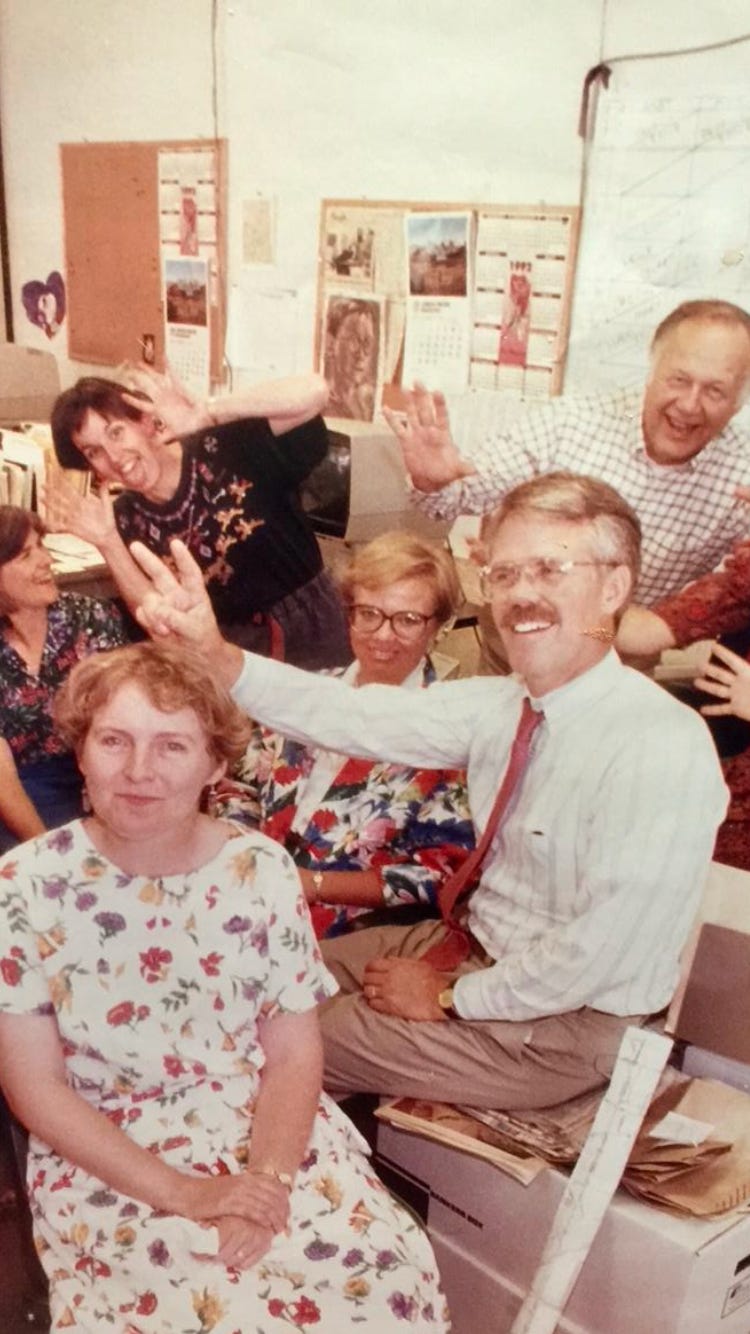
Let the good times roll. A break at the East Metro bureau of The (Portland) Oregonian sees Quinton Smith give rabbit ears to Kathleen Glanville in the 1990s. Jackie Scott, center, yet to become assistant bureau chief, kept her nose to the grindstone, sourcing her mind and a desk-top dictionary for the proper word, as all reporters did.
In mid brush stroke to canvas, my expressionist brother pivoted on the cluttered floor of a pre-9/11 Brooklyn loft and spoke:
“Writing is the hardest art form because it’s the most minimal—just letters cobbled together.”
My copy-editor mom, quoting a staffer at The (Portland) Oregonian, liked to say: “Easy reading is hard writing.”
Hollywood scriptwriters would agree on both accounts, voicing concern over artificial intelligence’s potential: Who needs to pay for screenplay when spot-on dialogue can be generated at the touch of a button?
Meanwhile, old-school journalists sweating over deadlines have greater things to worry about, mainly keeping their jobs when newspaper readership is dwindling as fast as a teen swiping over aerospace titanium.
Whether reporters know it or not—or even bother chewing it over at the water cooler—something else is at play:
Corporate software sucking up journalistic prose as swiftly as Hal knocks off David’s fellow astronaut in “2001: A Space Odyssey.” Bye-bye. All that hard work jettisoned into a black-hole free fall, and good luck stopping the free-for-all, with a pulsating red light at command.
Hal: “I’m sorry, Dave. I’m afraid I can’t do that.”
All that finely crafted copy edited to meet Associated Press standards and tweaked on occasion into sweet street-talk vernacular—something AI is still getting the hang of—is feeding a monster one day capable of spewing out not just facts but proper subject-verb agreement, play-on-words, double entendres and apt alliteration, enough to make lead sentences as catchy as “Call me Ishmael,” yet as current as a rapper’s ode to love gone bad in a hail of AR-15 gunfire on the Las Vegas Strip.
Word. Give it time.
Update: nine weeks later
Now exhale. It’s not there yet.
But.
See here: Spooked their own words have been looted, prominent authors have joined a class-action lawsuit against OpenAI for copyright infringement, with ChatGPT tied into the accusations, the Los Angeles Times reports:
https://www.latimes.com/entertainment-arts/business/story/2023-10-20/authors-ai-lawsuits-douglas-preston-george-rr-martin-michael-connelly
Widely read novelists have publishing houses, which have lawyers to look out for their writers’ interests. High-circulation newspapers, as in Los Angeles and New York, have got legal teams too, but more pressing matters than floating class-action lawsuits may be on their minds. Print-media tycoons like Charles Foster Kane belong to our silver-screen nostalgia. One of the world’s richest billionaires does own The Washington Post. Care to step up to the plate, Jeff Bezos?
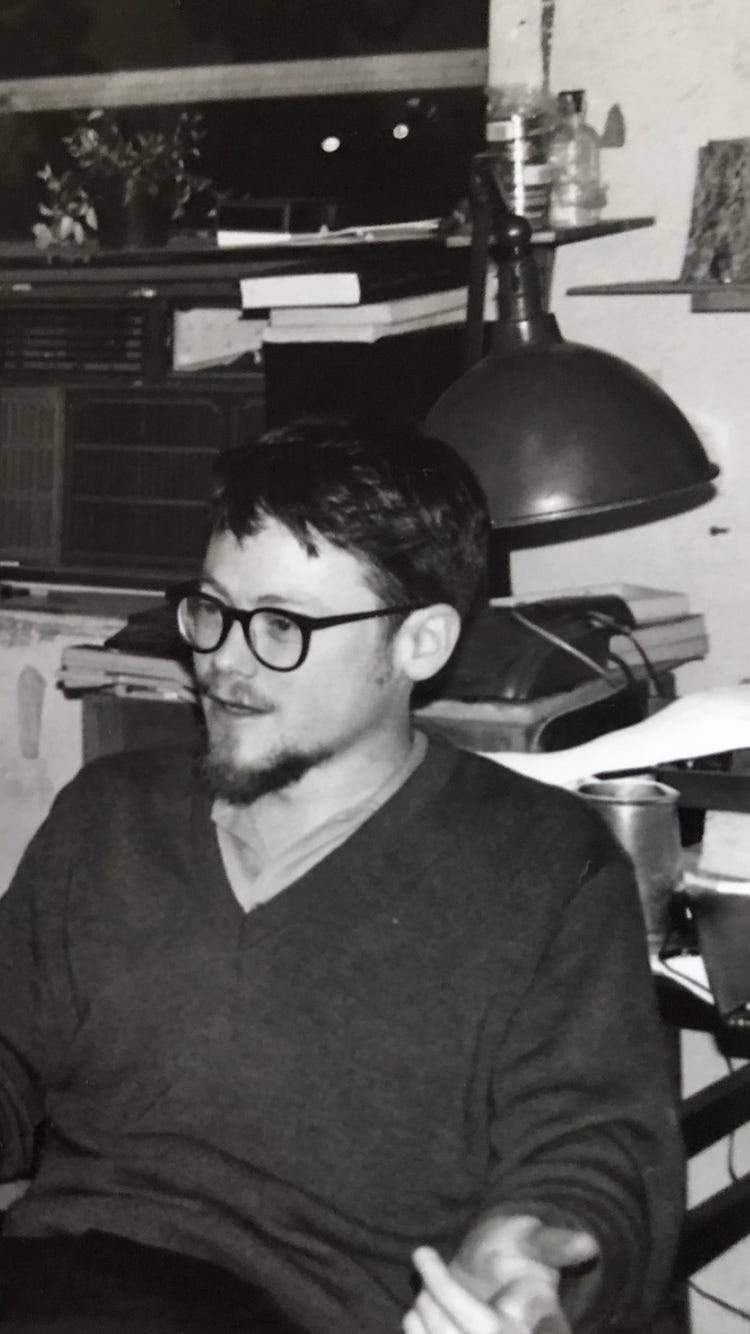
An on-task painter since age four, Roman Scott detested computers and wrote letters in Italic with a dip pen. Artificial intelligence would be able to reproduce his oils but not the thought process behind a work yet to be made. Pictured in his Brooklyn loft, he recorded surreal dreams in journals that he referenced for visual art.
***
The north Italian city of Milan is my home. LinkedIn enables me to see who has taken a glance at my articles on Italian culture, displaying demographic data tied to readers. Tempering perceived flattery, a fair share of views come from companies whose employees would seemingly have no interest in the reasons for Charlemagne’s siege on medieval Pavia or the finer points of amateur basketball in Novara. Other look-sees are of course legitimate, when the curiosity of a history professor or Division 1 coach is piqued.
Over the course of a year, businesses based around software technology have begun creeping into my LinkedIn readership. At first, satisfaction struck me. Ah, somebody cares. Hold on. Do they really? Web searches unpack their origins, with mission statements pointing to digital services, almost always vaguely described while rarely mentioning AI, which is only now garnering acceptance as a means for efficiency.
These cutting-edge data-collecting corporations are sometimes cryptically titled, borrowing from words rooted in Latin and bastardized French, otherwise given the blandest of names. They know who they are.
Among their missions, evidence would suggest, is thieving my stories.
Not appropriating whole pieces, of course, but most likely culling expressions, slang, and culture within context, all fed into a burgeoning data bank and then assimilated. AI, for example, would need to get a grip on the following quotes belonging to my stories:
Ebonics: “ ’Sup, Beatrice? How you been, girl?”
Stereotypes: “Italians were Al Capone, meatballs and spaghetti.”
Gambling: “We would play high-low. You would put a penny in your hand.”
Tackle football: “The flipper pad I would use to smack the blocker.”
Slowly but surely, AI’s catching up to speed through a bevy of nation-wide newspaper articles. Are my hunches off base? Sure, there’s a chance.
And global warming’s a myth.
But wait. Some Italy-loving geek in Silicon Valley might be building a summer itinerary that includes rubbing elbows with Neapolitans at Da Michele pizzeria, where the pecking order is written on scraps of paper. Naturally, my articles are just what the techie ordered, right?
Uh—no.
My Substack copy is small-fry, a nascent minnow in a sea of big dailies that churn out mega loads of riveting stories, far more accessible and infinitely more respected. Yet the most popular of my pieces appear on Google. Despite copyrighting its writers’ works, Substack would be an appealing target because it’s all about writing.
It’s all good.
Now you may thieve, AI. Go ahead, make my day.
Punk.
-30-